Gnolls
Vainqueur the DragonGnolls are hyena-like humanoids whose place in the story reflects the violent formation of Vainqueur Knightsbane’s frontier realm. They begin as scattered inhabitants of a dry, war-ravaged borderland, many of them tied by fear and obedience to Furibon, but are gradually drawn into Vainqueur’s service as laborers, soldiers, subjects, and potential food. Their treatment exposes the practical contradictions of monster civilization: Vainqueur can forgive and employ them, yet also disciplines them through lethal violence; Victor Dalton can promote them into stronger forms, yet still organizes their labor around the enormous feeding requirements of a dragon’s court. Gnolls therefore represent both a displaced local population and a crucial workforce in the construction of Murmurin’s emerging empire.
Homeland and Displacement
The gnolls live in the encampments south of the Castle of Murmurin, near a region that Vainqueur Knightsbane finds bleak and impoverished. The countryside around his volcano consists of badlands and arroyos, with brown soil, scarce vegetation, and the beginning of an immense red sand desert beneath the southern horizon. The remaining manlings occupy a small village at the mountain’s foot, while more primitive encampments stand near the desert’s border. Those southern encampments belong to gnoll tribes, making the gnolls among the established populations of the frontier rather than creatures newly summoned into it.
Their homeland has also been shaped by older imperial violence. Allison explains that the Sablaris once ruled much of the southern continent, Ishfania, and Barin, until cultists of Sablar the destroyer seized the empire and caused a magical cataclysm intended to accelerate universal entropy. The catastrophe transformed the Sablaris realm into a red desert. Brandon Maure later took control of the ruins of Ishfania with summoned monsters. The gnolls consequently inhabit a landscape produced by conquest, ecological devastation, and supernatural collapse, even though Vainqueur mainly views it in terms of its usefulness as a lair and source of provisions.
Service Under Vainqueur Knightsbane
Before Vainqueur’s arrival, the gnoll tribes lived in fear of Furibon. The lich permitted them to remain in the region and keep their gold only on the condition that they obeyed him. Most fled when Vainqueur warred against Furibon, while the few who stayed eventually came to Murmurin looking for work. Vainqueur condemns them for having knowingly served a cruel undead ruler, but he also forgives them and accepts them into his own service. This decision transforms their status from frightened subjects of one tyrant into laborers under another, more expansive regime.
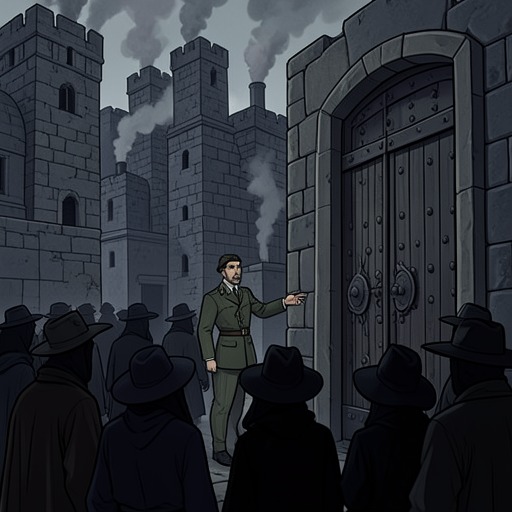
The gnolls become indispensable to the construction of the Castle of Murmurin. They carry most of the black stones used in the castle, while the males perform much of the physical labor under the supervision of the females. Vainqueur notices their spotted fur and clothing with amusement, treating their appearance as a spectacle even as their work enlarges his fortress. The building project includes a bridge for transporting raw material from the mountain and the reconstruction of towers destroyed during the War of the Hoard. In this setting, gnoll bodies are part of the material infrastructure of imperial display: their labor turns the volcanic lair into a more imposing seat of power.
Their integration is unstable. Vainqueur considers the gnolls lazy and cowardly in comparison with the zealous Kobold Rangers. They stop working whenever he is not watching and sometimes fight with other minions. His response is not negotiation or reform but exemplary punishment: he eats twenty troublemakers before the rest begin behaving. The episode establishes the brutal terms of their employment. Acceptance into Vainqueur’s service offers protection and work, but it does not remove the threat of being treated as expendable bodies within the food chain.
Labor, Food, and Settlement
Gnoll labor extends beyond castle construction. When Victor Dalton identifies the urgent need to feed the inhabitants of Murmurin, he organizes a large greening project. The land near the volcano is somewhat fertile, but the region is too dry to sustain the population and the coming Bragging Day feast. Gnolls dig canals from the sea toward Murmurin, while kobolds gather trees to shade grass. Other efforts include pits for drawing water from underground sources, magical plants suited to sandy soil, salt-removing plants, and experiments with seawater greenhouses.
The scale of the food problem places the gnolls inside a wider political economy of dragon rule. Victor calculates that Vainqueur’s average diet, including excess consumption, requires at least two hundred and fifty tons of meat for Bragging Day. Corpseling Jules translates that estimate into roughly two thousand five hundred well-fed sheep or four hundred cows per day. The canals and agricultural projects therefore do not merely beautify the wasteland; they are attempts to make a dragon-centered settlement materially possible. Gnolls are among the workers who convert a desert frontier into a managed supply zone, even though the primary beneficiary is a ruler whose appetite threatens to overwhelm the region’s resources.
Chocolatine’s ranch presents another version of the same problem. She experiments with feeding demon meat to pigs, which grow fatter and develop tiny horns, hoping eventually to breed demon pigs capable of sustaining the village. Gnolls are considered possible food by the imp population, and Chocolatine even contemplates acquiring gnoll leftovers after an imp rejects demon meat. This grim detail places gnolls simultaneously among the sentient laboring population and among the emergency resources imagined by other monsters. Their value is never governed by a single category: they can build, fight, reproduce, obey, or be consumed according to the hierarchy surrounding them.
Soldiers and Military Transformation
The gnolls also become part of Murmurin’s defense. When gargoyles, wyvern-riders, and a large land army of fiends and elf cattle attack the Castle of Murmurin, the invaders cross the canals built by Vainqueur’s minions and advance through his dominion with the intention of pillaging it. Gnolls stand among the defenders alongside kobolds, undead, mimics, and other servants. The environmental works that support settlement consequently become military terrain: the canals are no longer only instruments of irrigation but obstacles crossed by an invading army.
During the battle, Victor activates Rally Minion, raising all minions’ stats by one stage. He then selects ten gnolls for promotion, touching them one after another and declaring that they are receiving a pay raise. Their evolution is physically dramatic. They grow from small figures into three-meter-tall, monstrous, emaciated gnoll humanoids with skull-like faces and ashen skin; their eyes turn red with bestial fury. The transformation converts a previously unreliable labor force into a visibly formidable military asset, while the language of a pay raise frames advancement through supernatural evolution as compensation within a hierarchical workplace.
This promotion also parallels the evolution of the Kobold Rangers, whose members acquire different colored or skeletal forms. The distinction matters: the gnolls are not simply decorative recruits but a selected military bloc within Victor’s command structure. Their bodies become legible as weapons, and their earlier reputation for cowardice is overwritten by a new form associated with violence and battlefield usefulness. The scene marks their movement from tolerated subjects to empowered agents of Murmurin’s defense, although the power still comes through promotion by a superior rather than through independent political authority.
Presence in the Wider Monster Community
Gnolls appear throughout the broader social world of the novel, not only inside Vainqueur’s court. Croissant explains that intelligent monsters disguise themselves as humans because inquisitors and adventurers regularly travel through the region and otherwise attempt to exterminate them. The existence of a school where mimics and other shapeshifters learn to blend into a safe environment shows that monster communities develop institutions for survival under human persecution. Gnolls belong to this wider population of nonhuman beings navigating concealment, coexistence, and organized defense.
The Moon Man cult likewise includes gnolls among its followers or participants. When Victor Dalton encounters the cult’s excessive interest in him, he sees werewolves in human form as well as furry gnolls, kobolds, mimics, and festering ghouls. Their appearance in this crowd demonstrates that gnolls can be connected to religious and reproductive networks beyond Murmurin’s official hierarchy. They are not merely castle laborers; they participate in the unstable, comic, and threatening social formations created by monster communities across the region.
After Bragging Day, gnolls remain among the servants summoned to Vainqueur’s side with the Kobold Rangers, mimics, and other minions. The landscape has been left like the aftermath of a volcanic disaster, with houses overturned and no sheep alive, yet the administrative machinery of the court continues. When Victor cannot immediately be found, Vainqueur assigns the Kobold Rangers responsibility for leading the minions on subsequent missions, implicitly leaving the gnolls within that organized body of dependents. Their continued presence after the feast confirms that they have become a durable component of Murmurin rather than temporary wartime auxiliaries.
Narrative and Political Significance
Gnolls embody the frontier’s conversion from abandoned or devastated land into a contested state. Their tribes are displaced by the wars of Furibon, recruited by Vainqueur, employed in castle building and ecological engineering, and later incorporated into military formations. Their story intersects with the proposed treaty under which Gardemagne recognizes Vainqueur’s claim to Ishfania as an official adventurer state. That treaty would allow Vainqueur to rule the territory while promising that Gardemagne and the new state would not take arms against one another and would unite against outside threats. The gnolls’ labor and military service help make such territorial recognition materially credible: empire is not created by a title alone, but by workers who build its fortifications, alter its environment, and defend its borders.
At the same time, the gnolls expose the limits of the novel’s comic monster politics. Vainqueur speaks of a food chain in which each member may eat those below when hungry, and he regards Victor as almost an honorary part of his hoard while still allowing the possibility that minions might become emergency rations. He teaches that breeding should be based on the size of a creature’s hoard and suggests that creatures who die frequently must reproduce to prevent extinction. Against this framework, Jolie argues that sentient beings possess souls and that eating them or abducting their princesses is morally wrong. Vainqueur rejects the principle for manlings but makes an exception for elves, while Victor points out that elves are people too. Gnolls occupy the unresolved middle of this hierarchy: they are intelligent enough to work, fight, worship, and join political communities, yet they remain vulnerable to being classified as livestock or expendable prey.
Their recurring movement between victimhood, usefulness, and danger gives them a distinctive narrative function. They are survivors of imperial catastrophe and Furibon’s coercive rule, but they also become participants in Vainqueur’s own coercive order. They are comic figures in the eyes of their dragon ruler, unreliable workers who must be disciplined, essential builders of a desert castle, agricultural laborers in a desperate food project, and newly empowered soldiers defending the same regime that employs them. Through the gnolls, the story presents monster civilization not as a clean alternative to human domination but as a rough, violent process of settlement in which protection and exploitation are inseparable.